
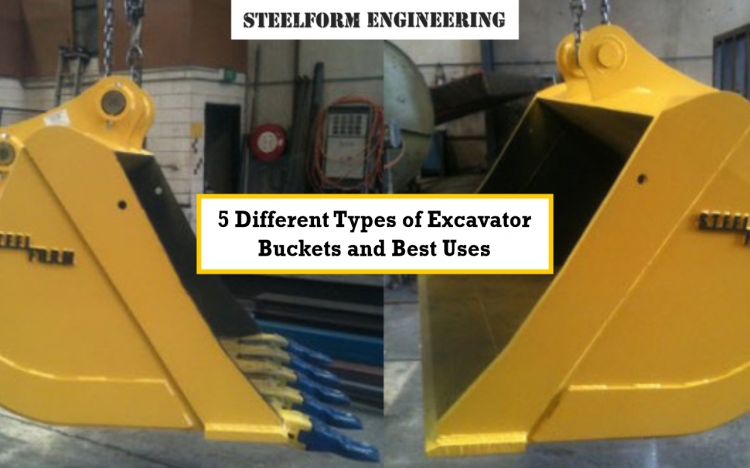
Choosing the right bucket for your excavator is the best way to get more work done on the job site and use less fuel.
If your excavator has an attachment that doesn't fit properly, it has to work harder, which wears it out faster and raises your maintenance costs. In Australia, the bucket should be matched to the type of terrain where it will be used. For example, in Melbourne, the terrain is clay, but if you're using a bucket in the rough outback quarries, you need a different bucket that is safe to use in that environment and gives you the most work done. We at Steelform Engineering design and build excavator attachments that work well in any setting.
The general-purpose bucket is the most versatile attachment found on any excavation or construction machine and is often referred to as the "workhorse" of the construction and earthmoving industries.
The general-purpose bucket is equipped with sharp teeth on the front edge, allowing it to penetrate and scoop various materials, such as topsoil, sand and clay. This excavator attachment is used primarily to perform a variety of tasks at construction sites, including site preparation, foundation excavation, and light landscaping. One of the benefits of using a light-duty general-purpose bucket, compared to a heavy-duty bucket, is faster cycle times on non-abrasive material.
Rock buckets have been designed with structural reinforcement to withstand heavy impact & abrasive materials that would otherwise destroy a standard GP bucket.
They are built with quench & temper high-tensile steel, making their side plates very thick & rock teeth very robust. Whether you’re working in a quarry or breaking up compacted rock such as shot limestone or basalt, the use of a rock bucket will protect your machine’s arm and pins from the high breakout forces at that point.
V-buckets, or trapezoidal buckets, are specialised attachment tools for digging very accurate sloped trenches in one pass.
The V-shape is ideally suited for drainage trenches, irrigation channels, and side ditching where a specific bank angle is required. These buckets cut the exact shape, so they create little or no soil displacement and can save considerable time on manual finishing. This makes them an economical solution for civil engineering projects or for any large-scale agricultural project.
Utility buckets feature a rounded, smooth-edged design to provide greater safety while digging in areas with underground utilities.
These utility buckets are vital for all types of urban excavations where water pipes, gas mains, and electrical cables exist. Due to the Uni-tusk shape of the bucket, the operator has confidence in their ability to safely excavate and prevent any snagging or puncturing of services that may be buried. It is also required as standard safety equipment on most Australian telecommunications and council infrastructure projects.
Skeleton buckets have a gridded design which enables on-site sortation of materials as they are lifted. This is also called a sieve bucket, because the bars are spaced apart, allowing the fine soil or sand to pass through and keeping larger rocks or debris.
Skeleton or sieve buckets also work very well for cleaning up job sites, recycling demolition waste, or producing topsoil for future landscaping applications. Screening buckets, on the other hand, have rotating shafts and work at the job site to separate materials into size, thus turning waste into reusable fill material.
Choosing the right excavator bucket for your project will save you money by reducing the reparation work necessary to complete your project and increase the life of your equipment.
At Steelform Engineering, our excavator buckets have been designed to manufacturing standards. All of our excavator buckets are built to withstand all the conditions. No matter where you are in Australia, we supply custom excavator buckets and heavy-duty rippers to provide your machine with maximum performance on the job site.
The right excavator bucket is very important for the safety and success of your project. When selecting the correct excavator bucket, from V-shaped trenching buckets to structural rock buckets, selecting the right type of bucket for the type of terrain is critical. Operators in Australia that use the correct excavator bucket type will see a reduction in fuel consumption and less wear and tear on their equipment.
Customised buckets for excavators are very useful when the conditions at the job site call for more accuracy, durability, or performance. Steelform Engineering makes and designs high-quality, custom solutions for all civil, mining, and earthmoving projects. If you need to make your equipment work better or are having trouble on the job site, contact us and let our experienced team help you find the best custom solution for your project.
At Steelform Engineering, we are proud to manufacture the strongest, most durable, and most reliable excavator buckets available to tackle the toughest work sites in Australia.


